
An alarming picture
by: Jon Brunberg | 17/12/2023 3:28:49 pm
The latest figures from Uppsala Conflict Data Program, UCDP, paints a picture that should be cause for alarm: the number of armed conflict in the world has not been this high in decades. In 2022 UCDP recorded 187 active armed conflicts in three main categories: state-based, non-state and one-sided violence. It's the highest figure since they first started to publish records in all three categories in 1989. Most remarkably the number of state-based conflicts has soared, from 31 active conflicts in 2010 to 56 in 2022.
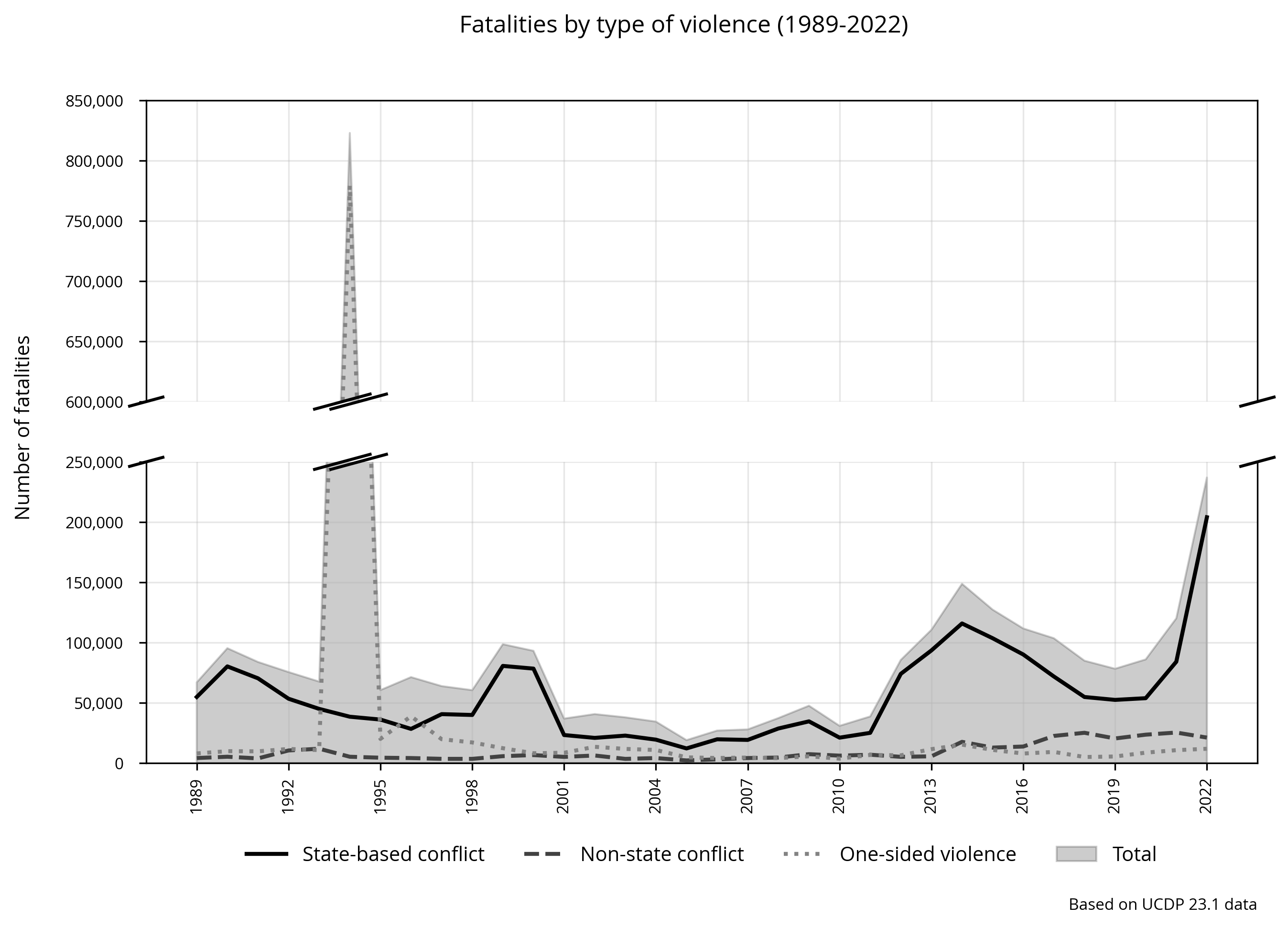
Even more alarming is the fact that the number of fatalities in armed conflicts are at a record high. Never since the fall of the Soviet Union has so many died because of war, except only for the horrific exception of the Rwandan Genocide of 1994.
For this project I maintain a list of wars since 1900 based on data from Correlates of War, PRIO and UCDP. It was made to give a global overview of all the wars in the world based on the best academic research available through open sources. In theses troubling times it seems appropriate to update it with the most recent data. As this is a nonprofit project this usually takes a couple of months. You are warmly welcome to follow the process at war-memorial.net and the project's facebook page.
Jon Brunberg
Stockholm 17 december 2023
Chart: UCDP, fatalities by types of violence 1989-2022. Based on data from UCDP 23.1. Graph from https://ucdp.uu.se/downloads/charts/. Source: Davies, Shawn, Therese Pettersson & Magnus Öberg (2023). Organized violence 1989-2022 and the return of conflicts between states?. Journal of Peace Research (Forthcoming).
Notes on the Online Memorial Collection
by: Jon Brunberg | 19/07/2016 1:29:33 pm
When you’re contemplating the features and functions of contemporary war memorials, it’s almost impossible not to take the names of the killed into consideration. When I begun to work on the Polynational War Memorial project in 2004 I decided that I would follow that convention and make the names of all soldiers and civilians killed because of acts of war a fundamental part of the design. And I started to gather all those link in a separate section called "The Online Memorial Collection". This article discuss the importance of names and numbers.
Contrasting impressions on Omaha Beach
by: Jon Brunberg | 19/08/2013 7:12:21 pm
The second article in a series of reports from a trip to the D-Day landing beaches in Normandy and its surroundings that was made by the author in August 2009.
Wanås Master Plan: documentation video
by: Jon Brunberg | 13/08/2013 10:11:14 am
In early 2008 I was invited by the curators Marika Wachtmeister and Elna Svenle to present the Polynational War Memorial at Wanås Art, which is located on the estate of Wanås Castle in Southern Sweden. This cooperation resulted in the first full scale experiment of the Polynational War Memorial being created for the park of the estate. The video presented in connection with the article documents the process of creating this work.
Le Mémorial in Caen - Narratives of War and Peace
by: Jon Brunberg | 18/11/2009 2:36:54 pm
The first in a series of reports from a trip to the D-Day landing beaches in Normandy and its surroundings that was made by the author in August 2009 describing a visit to Le Mémorial or Musée Mémorial de la Paix (the Memorial Museum for Peace).

War memorial by Claes Sörstedt for A10
by: Jon Brunberg | 15/01/2008 1:00:00 am
/headline/ War memorial /Ingress/ The Swedish artist Jon Brunberg is planning a series of monuments commemorating all humans killed in wars since May 1945.

The desolate silence of minimalism
by: Kieran Long | 22/03/2007 1:00:00 am
We live in an era of memorial inflation. In my hometown of London there seems to be a solemn dedication of some kind every other month, often for events and wars long past. Elsewhere, the huge and expensive memorial to the September 11th terrorist attacks is in the final stages of design, dwarfing in size and certainly cost any previous memorial, even those for world wars.

Workshop Dossin-Mechelen Report
by: Jon Brunberg | 22/03/2007 1:00:00 am
A report from the workshop "Dossin-Mechelen: Rethinking the future of symbolic places" in Mechelen, Belgium March 13-18 2007.

Rapport från workshopen Dossin-Mechelen
by: Jon Brunberg | 22/03/2007 1:00:00 am
Den 13-18 mars arrangerades en workshop med titeln "Dossin-Mechelen: Thinking the future of symbolic places" i den Belgiska staden Mechelen. Workshopen samlade 140 magisterstudenter från hela Europa och jag var inbjuden som föreläsare och handledare för en studentgrupp. 25000 Holländska och Belgiska judar deporterades av Nazisterna från Mechelen under andra världskriget och nu planerar staden att anlägga en minnesplats för att hedra offren. En rapport från workshopen finns nu att läsa på webbplatsen.

Freedom Park at Salvokop Hill, Pretoria, SA: OBRA Architects, New York
by: Jon Brunberg | 20/10/2005 1:00:00 am
OBRA ARCHITECTS was founded by Pablo Castro and Jennifer Lee in New York in 2000. The firm has completed many projects including the San Jose Veterans Memorial. In 2003 they were elected one of three winners in the competition for the Freedom Park memorial and museum complex at Salvokop Hill in Pretoria, South Africa. This museum and memorial complex will become South Africa´s main post-colonial monument, which will function as a commemorative site for the struggle against apartheid and a symbol for the new South African nation. It will also be a site for gatherings and religious cleansing ceremonies for the country´s many ethnical groups. In this interview, which was made by e-mail in October 2005, Pablo Castro explains the concept behind OBRA´s proposal and their view on the emotional aspects and the complex issue of remembrance that are immanent in the process of designing memorials relating to conflict.
Holocaust Memorial: Architect Peter Eisenman, Berlin 2005
by: Sarah Quigley | 21/09/2005 1:00:00 am
One month before the much-debated Holocaust Memorial was due to open, the site was still in chaos. Berlin has a history of not finishing projects on time, and Eisenman’s Memorial looked like being yet another casualty. Workmen sat about looking exhausted while tourists peered curiously through the construction fence.
A SMALL ORANGERY IN STOCKHOLM
by: Jon Brunberg | 15/06/2005 1:00:00 am
Memorials are After All Only Symbolic Works of Art
by: Jon Brunberg | 22/05/2005 1:00:00 am

Cross-National Commemoration In The Iraq War
by: Jon Brunberg | 28/12/2004 1:00:00 am
The exhibition and memorial "Eyes Wide Open" in the USA and the name reading ceremony "Naming the Dead" in the UK are successfully creating new ways of honouring the killed in a conflict, in this case the war in Iraq, which includes soldiers and civilians regardless of nationality.

Counting the Dead - The Iraq Body Count Project
by: Jon Brunberg | 28/12/2004 1:00:00 am
An interview with John Sloboda, who founded the Iraq Body Count project together with Hamit Dardagan, about the internet-based project that for a long time was the only available source in the West about killed civilians in the war in Iraq.

Nationsöverskridande minnesmonument i Irakkriget
by: Jon Brunberg | 28/12/2004 1:00:00 am
Utställningen och minnesmonumentet "Eyes Wide Open" i USA och namnläsningsceremonin "Naming the Dead" i Storbritannien visar på ett nytt sätt att hedra dödade i en konflikt, i detta fall kriget i Irak, där både soldater och civila av alla nationaliteter hedras.
Att räkna de dödade - Iraq Body Count
by: Jon Brunberg | 28/12/2004 1:00:00 am
En intervju med John Sloboda som tillsammans med Hamit Dardagan grundade Iraq Body Count, som länge var den enda tillgängliga källan om dödade Irakiska civila.
AN INTERVIEW WITH PETER TONKIN
by: Jon Brunberg | 05/07/2004 1:00:00 am
This interview with Australian architect Peter Tonkin was made in the office of the architect bureau, Tonkin Zulaikha Greer, in Sydney in Nov 2003. Peter Tonkin has designed several war memorials, often in collaboration with artists, for example the Memorial to the Australian Forces in the Vietnam War, in Canberra, and the Memorial to the Australian Forces in WWI and WWII, in London.

OUR TRAIL OF THE TROUBLES
by: Jon Brunberg | 16/06/2004 1:00:00 am
An article about Hillary Gilligan's intervention "Our Trail of the Troubles", made in Belfast 1996. There are virtually no multilateral war memorials at all in the world, which is perhaps not too surprising. The process of creating such a memorial must be a painstaking process that can take years if not generations. A peace process must first be negotiated, parties must agree and cultural gaps must be bridged before the work with a memorial can even begin. When Hilary Gilligan made her intervention in public space on the Easter weekend in 1996, she showed that a war memorial doesn't have to be commissioned, or permanent, to be successful.

KRISTINA CEDRINS: A MULTILATERAL WAR MEMORIAL
by: Jon Brunberg | 01/06/2004 1:00:00 am
This is a presentation of Krisitna Cedrins proposal for a multilateral war memorial as presented at the course at the School of Architecture.
COURSE AT THE SCHOOL OF ARCHITECTURE
by: -- | 21/03/2004 1:00:00 am

 News
News
